
Mileage Deduction Calculator
Estimate your tax savings from business mileage deductions.
Based on IRS standard mileage rates. Actual savings depend on your individual tax situation.
Track every mile automatically
SparkReceipt's mileage tracker is coming soon. Be the first to know when it launches.
How the IRS Mileage Deduction Works
Standard mileage rate vs. actual expenses
The IRS lets you deduct business miles at a flat rate — 70 cents per mile in 2025, 72.5 cents per mile in 2026. You have two options:
-
Standard Mileage Rate — Multiply your business miles by the IRS rate. Simple, no receipt tracking for gas or maintenance needed.
-
Actual Expense Method — Track every vehicle cost (gas, insurance, repairs, depreciation) and deduct the business-use percentage.
Most self-employed workers choose the standard rate because it's simpler and often produces a comparable deduction. The actual expense method can yield more if you drive an expensive vehicle with high maintenance costs.
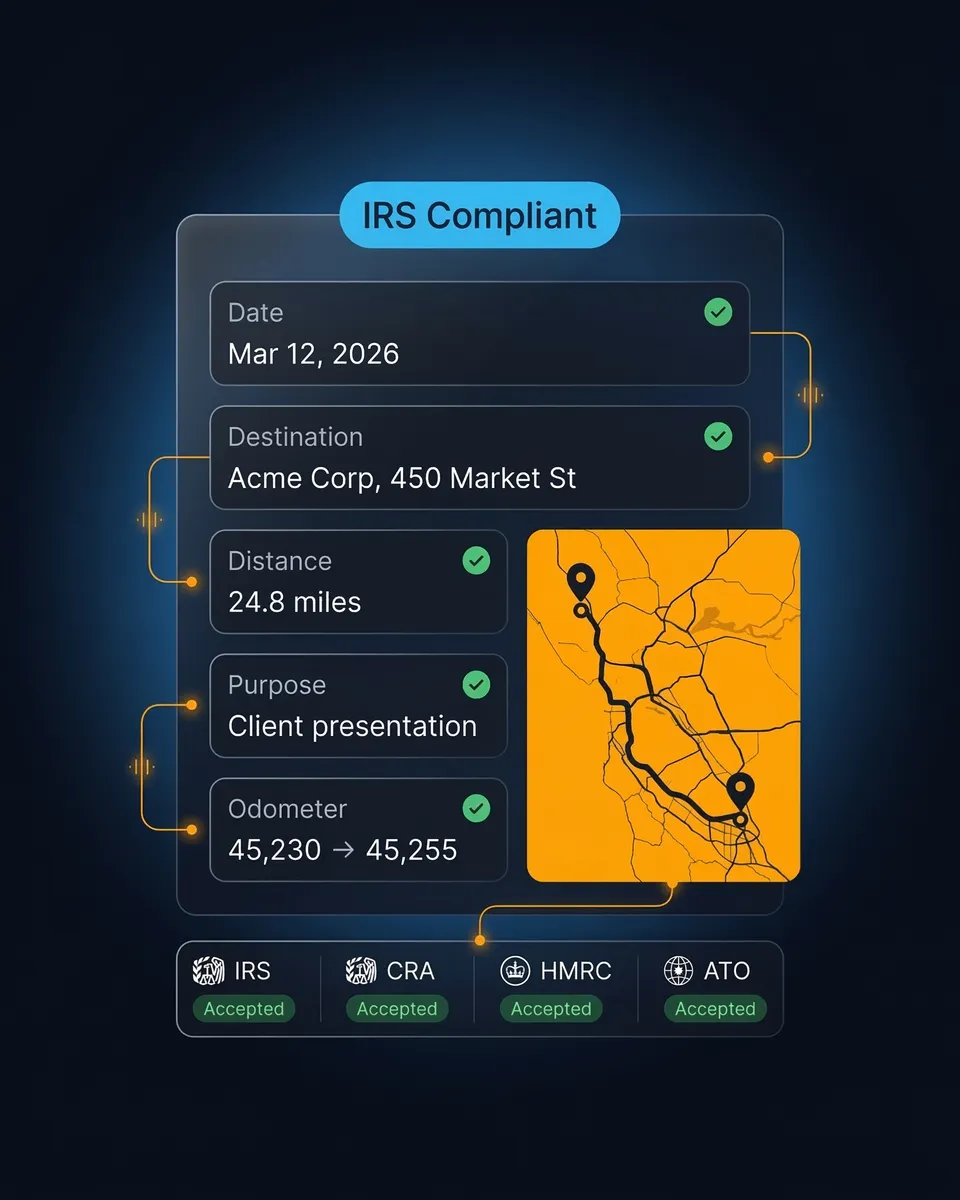
Whichever method you choose, the IRS requires a contemporaneous mileage log with the date, destination, business purpose, and odometer readings for every trip.
Standard Mileage vs. Actual Expenses: Which Saves More?
Compare both methods to maximize your deduction
| Factor | Standard Mileage | Actual Expenses |
|---|---|---|
| Best for | High-mileage, fuel-efficient cars | Expensive vehicles, high repair costs |
| Tracking effort | Mileage log only | Every receipt + mileage log |
| First-year requirement | Must choose in first year of use | Can switch from standard later |
| Depreciation | Built into the rate | Claimed separately (MACRS) |
| Lease restrictions | Must use for entire lease term | Can switch year to year |
Pro Tip: Calculate both methods in your first year of business use. If the actual expense method gives a bigger deduction, you can always switch back to standard mileage in future years. But if you start with actual expenses on a car you own, you cannot switch to standard mileage for that vehicle.
How to Maximize Your Mileage Deduction
Commonly missed deductible trips
- Driving between job sites or client meetings
- Trips to office supply store, post office, or bank for business
- Driving to professional development events or conferences
- Travel to temporary work location (under 1 year)
- Rideshare and delivery driving (miles between pickups count too)
Not deductible: Your regular commute from home to your main office.
Home office exception: If you have a qualifying home office, every business trip from home becomes deductible since your home is your principal place of business.
The average self-employed worker drives 12,000–15,000 business miles per year. At the 2026 rate of 72.5¢/mile, that's an $8,700–$10,875 deduction — saving you $1,331–$1,664 in self-employment tax alone.
The key is consistent tracking. Start logging every trip from day one with a mileage tracking app so you never miss a deductible mile.
Frequently Asked Questions
The IRS standard mileage rate for 2026 is 72.5 cents per business mile, up from 70 cents in 2025. Medical and moving mileage (for active military) is 21 cents per mile, and charitable driving remains at 14 cents per mile.
Generally no. The Tax Cuts and Jobs Act (TCJA) eliminated the unreimbursed employee expense deduction for W-2 employees from 2018 through 2025, and the One Big Beautiful Bill Act (OBBBA) made this permanent. Only self-employed individuals, independent contractors, and business owners can claim the mileage deduction.
Yes. The IRS requires contemporaneous records with five elements: the date of the trip, destination, business purpose, and odometer readings (start and end). Without a proper log, the IRS can disallow your entire mileage deduction in an audit. Digital mileage tracking apps are accepted as valid records.
It depends. If you used standard mileage in the first year you placed a car in business service, you can switch to actual expenses in a later year. However, if you chose actual expenses first (on a car you own), you generally cannot switch to standard mileage for that vehicle. For leased vehicles, you must use the same method for the entire lease term.
Yes. The mileage deduction reduces your net self-employment income on Schedule C, which directly lowers both your income tax and your self-employment tax (Social Security + Medicare). At the 15.3% SE tax rate, every $1,000 in mileage deductions saves you an additional $153 in SE tax on top of your income tax savings.
Business mileage includes driving between work locations, trips to clients or customers, travel to business meetings, runs to the bank or post office for business, and trips to buy supplies. Your regular commute from home to a fixed office does not count. However, if you have a qualifying home office, all business trips from home are deductible.